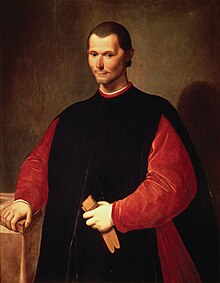
(The following is an essay I wrote for my "Morality and Politics" course at the University of Texas at Austin. The prompt I responded to was as follows: "The term “Machiavellian” is typically used to mean someone devious; that is, both clever and wicked. Based on what we read in the Prince, does this word, as we now use it, accurately capture Machiavelli’s teaching? Why or why not?" The only work cited is the Second Edition of "The Prince" by Niccolò Machiavelli, as translated by Harvey Mansfield.)
To rewrite a quote from Richard Nixon- one of the most infamous descriptions that history can bestow is the title of Machiavellian. That I should start this essay with a reference to the 37th President is appropriate, given Nixon's status as perhaps the greatest "Machiavellian" figure of modern times. The original quote, taken from his first inaugural address, was that "the greatest honor history can bestow is the title of peacemaker"- an honor that President Nixon claimed to aspire to with regards to America's then ongoing war in Vietnam. Over the course of the next several years however, Nixon would secretly, and at times illegally, escalate a war he knew that the United States could not win, merely in the hopes of gaining a "decent interval" between US withdrawal and South Vietnamese collapse so that his administration could save face. Such willingness to end human life for the sake of one's reputation has come to be the distinguishing characteristic of the "Machiavellian" politician- clever, deceitful, and willing to do whatever it takes to gain power and a name for toughness. But does the contemporary image of Machiavellianism conform to the actual teachings of Machiavelli himself, or has his name taken on a life of its own over the years that distorts his original teachings and inaccurately paints him as a "teacher of evil?" A close and objective reading of The Prince reveals it to be the latter. Far from being a "teacher of evil," Machiavelli was a man who merely spoke the truth of the events of the past, and described the means that must be employed if one is to have realistic hope of achieving desired ends. Most importantly however, "the desired ends" that Machiavelli himself sought in his writings, and that the application of his ideas ultimately achieved, was a world infinitely freer, happier, and more honest with itself than the one he lived in- a world where a taming of "fortune" and an acknowledgment of reality would render the harsh measures he recommends no longer necessary, and where the prosperity and security of the people would be assured as a result.
In Chapter 15 of The Prince, often described as the most important chapter of this most important work, Machiavelli makes explicit that which should have already been obvious to anyone who had read his treatise to this point by declaring his break with the idealism and deliberate omission of the truth that characterized the writings of previous thinkers:
"...Many have imagined republics and principalities that have never been seen or known to exist in truth; for it is so far from how one lives to how one should live that he who lets go of what is done for what should be done learns his ruin rather than his preservation. For a man who wants to make a profession of good in all regards must come to ruin among so many who are not good. Hence it is necessary to a prince, if he wants to maintain himself, to learn to be able not to be good, and to use this and not use it according to necessity." (61)
This passage is often cited in support of the argument that Machiavelli is a "teacher of evil," who gave his readers the green light to "be able not to be good." Such an interpretation however ignores the rest of the passage, in which Machiavelli stated quite clearly why it is sometimes necessary to not be good- the fact that the world is and always has been inhabited by people "who are not good." By giving license to fundamentally good people to not be good when necessity requires it, Machiavelli is not making life easier for people already inclined to be bad (they would hardly need his endorsement to convince themselves "not to be good"), he is giving good people the means by which to oppose them. For as he says in Chapter 18:
"...There are two kinds of combat: one with laws, the other with force. The first is proper to man, the second to beasts; but because the first is often not enough, one must have recourse to the second. Therefore it is necessary for a prince to know well how to use the beast and the man... And if all men were good, this teaching would not be good; but because they are wicked and do not observe faith with you, you also do not have to observe it with them." (69)
This is not a repudiation of the desire to be good; conversely, it is a brave acknowledgment of the truth that only a fool would expect all people to be good at all times; and in a world in which so many are not good, anyone who realistically hopes to accomplish anything in the world must be willing to "not be good" if and when those who oppose them decide likewise. If this acknowledgment makes Machiavelli a "teacher of evil," then the acknowledgment on the part of biologists that predators, such as sharks, prey on weaker species, such as minnows, must make them the same.
Proponents of the "Teacher of Evil" school however, argue that Machiavelli was not just acknowledging that sharks prey on minnows- he was encouraging them to do so. Indeed, passages from The Prince such as Machiavelli's seeming adulation of figures like Agathocles and Severus [praising the former for his "virtue" and "greatness of spirit" (35), and the latter as "a very fierce lion and a very astute fox" (79)], if taken at face value, do his apologists no favors in their attempts to refute this view. The problem, however, lies in the very act of taking such passages at face value, and failing to put Machiavelli's words into the proper context of the extremely cruel and harsh times in which he lived, as well as his broader mission in writing The Prince of creating a new political order that takes account of this reality and, by doing so, is more secure and less needful of such cruelty. Machiavelli was not imploring his Prince to make a habit of slaughtering his potential political opponents in cold blood and without provocation as Agathocles did, or of oppressing his own people as Severus did- rather, he was once again acknowledging that these things sometimes happened in the cruel and vicious world of pre-modern politics. Agathocles and Severus had to use the means that they did if they were to succeed in accomplishing their ends (which they did). If the "new prince" that Machiavelli writes for is to accomplish any of the weighty tasks that his instructor has assigned him (such as, "to seize Italy and to free her from the barbarians," as the title of the final chapter of the book not-so-subtly declares), he must be similarly prepared to resort to harsh measures as well. But in order for Machiavelli's readers to be satisfied that the ends he seek justify the rather brutal means that he is prepared to resort to, we must first know what those ends are. The answer to that question is the only thing that can settle the issue of whether or not Machiavelli is a "teacher of evil" who deserves the infamy that his name now implies.
Taken out of context, much of The Prince is extremely easy to interpret as the amoral precepts of a man advising the strong on how to dominate the weak. On the contrary however, Machiavelli explicitly and repeatedly advises his new prince to found on the people rather than the great, because according to him (using moralistic language rarely found in The Prince), "the end of the people is more decent than that of the great, since the great want to oppress and the people want not to be oppressed" (39). Indeed, only taken in full can The Prince be appreciated for what it is- far from a celebration of cruelty and deviousness, it is a mandate for those in positions of authority to use that authority to destroy the cruel, old order that reigned supreme in Machiavelli's time, using the harsh means that sustained that order against it when necessary, and to build in its place a new one founded on the people, based upon reason, and exemplary of "humanity and munificence:"
"A prince should... show himself a lover of the virtues, giving recognition to virtuous men, and he should honor those who are excellent in an art. Next, he should inspire his citizens to follow their pursuits quietly, in trade and in agriculture and in every other pursuit of men... But he should prepare rewards for whoever wants to do these things, and for anyone who thinks up any way of expanding his city or his state. Besides this, he should at suitable times of the year keep the people occupied with festivals and spectacles. And because every city is divided into guilds or into clans, he should take account of those communities, meet with them sometimes, and make himself an example of humanity and munificence, always holding firm the majesty of his dignity nonetheless, because he can never want this to be lacking in anything." (91)
Sound familiar? The world that Machiavelli is describing as the ideal sounds eerily like the one that we live in today- one that he played a decisive role in creating, and is infinitely happier than the one that he himself had to endure.
Only in the light of the world that Machiavelli was trying to create can the darkness of some of the earlier chapters of The Prince be illuminated and seen for what they are- a frank acknowledgment of the harsh measures that would be (and ultimately were) necessary if ever the task of reforming the corrupt political system that reigned in the Europe of Machiavelli's time was to be undertaken. "...It appears to me that so many things are tending to the benefit of a new prince," Machiavelli wrote, "that I do not know what time has ever been more apt for it" (102). Only through a frank acknowledgment of the cruel measures that often succeeded in the past however, could this "new prince" succeed in taking the proper measures to tame the "violent river" (98) of fortune and chance, and provide security against it- thus creating the world of peace and harmony in which we now live. It is increasingly easy, removed as we are in the 21st Century from the harsh measures that had to be applied in order to grant us the freedom and luxury we now enjoy, to fault Machiavelli for the brutality of some of his recommendations. My suspicion however, is that if we people today were somehow given the option to press a "reset" button, and undo the harsh measures that had to be undertaken in order to create the modern world, we would find to our surprise that, to rewrite another popular Nixon quote, we're all Machiavellians now.*

No comments:
Post a Comment