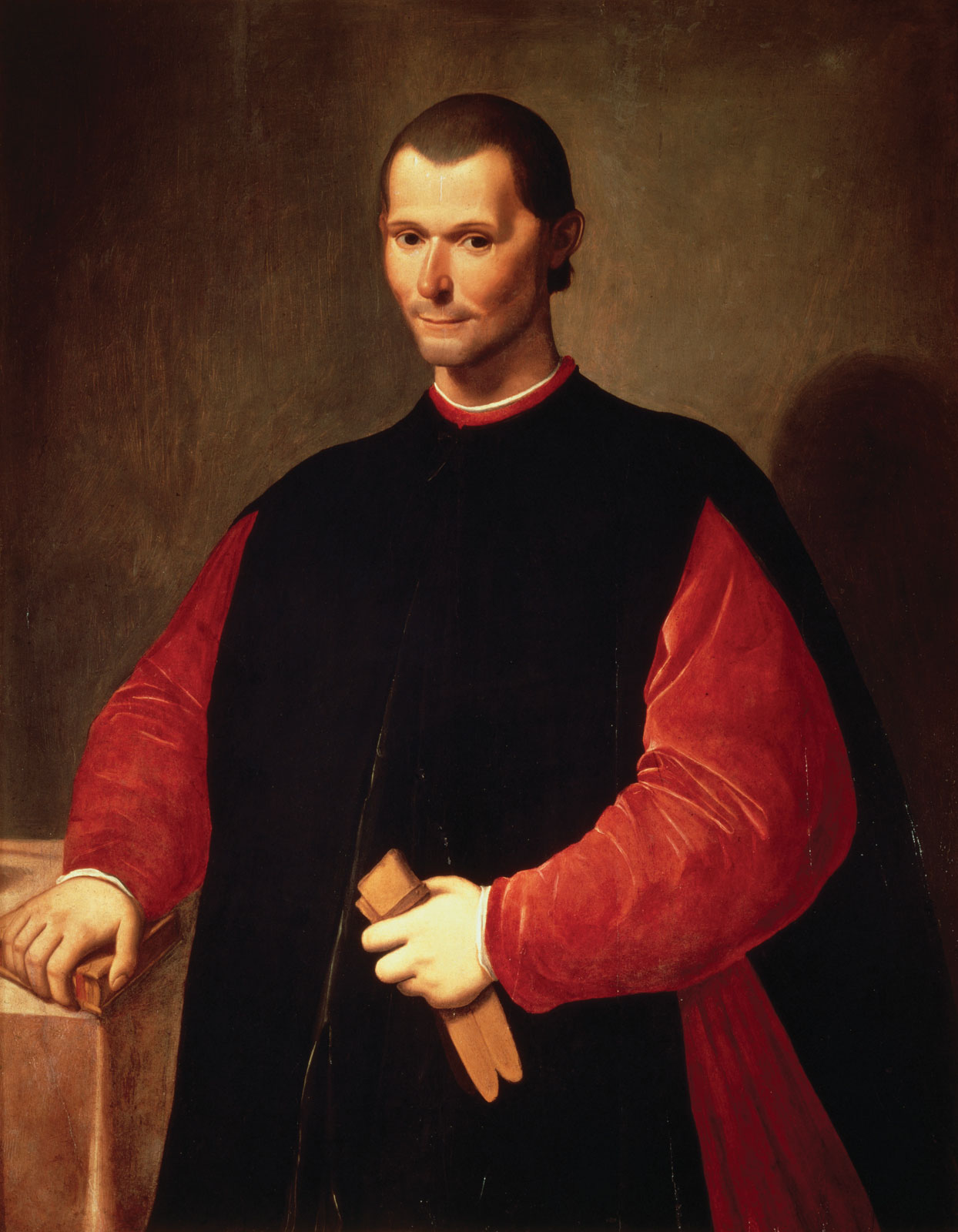
(Portrait of Niccolò Machiavelli by Santi di Tito)
With Christmas break almost over, I have been scrambling the past few days (hence the absence of a new post yesterday) to get all of my affairs in order prior to returning to my beloved University of Texas at Austin on Sunday for a new semester. Much like the dawn of a new year, the dawn of a new semester always give me reason to reflect back on everything that I learned and accomplished in the previous semester and the many ways in which I hope to build upon that foundation in the new term. Last semester, one such foundation was perhaps my favorite and, probably, most intellectually stimulating course I have taken to date- "Theoretical Foundations of Modern Politics" with Dr. Devin Stauffer. In reading The Prince by Niccolò Machiavelli, Leviathan by Thomas Hobbes, The Second Treatise of Government by John Locke, The First and Second Discourses by Jean-Jacques Rousseau, and Thus Spoke Zarathustra by Friedrich Nietzsche, the class- to quote Professor Stauffer- "witnessed the birth of our brains." Accustomed as we are to living in 21st Century civilization, we take for granted such concepts as democracy, checks-and-balances, commercialism, the natural equality of human beings, and tolerance of differing world views, and seldom give pause to consider the fact that there was a time when those ideas, far from being accepted as self-evident, were violently suppressed. The free and prosperous world we live in today, a world we too often bitch about rather than enjoy, emerged out of a very different, more pious, submissive, and impoverished world- a world in which reason was shunned for faith and superstition; a world in which equality was despised, while the divine right of kings and aristocrats was extolled; and one in which freedom was stifled and pious submission to arbitrary authority was the norm.
Certainly, our current system isn't perfect and has many failures (foremost among them, that it fails to educate we lucky people who live in this age just how well we have it compared to those who suffered under the yoke of the medieval system that preceded ours), but I consider it one of my greatest duties in life to remind everyone just how well we have it. Say that our world is empty and materialistic, I might agree with you. Say that it is lackadaisical and that people today don't know commitment or exertion, I might agree with you. But say that those who lived under the system of religious tyranny and oppression that preceded ours knew better, and I will oppose you most vigorously. The very fact that we can casually comment on the failures of our current system is a testament to one of that system's greatest successes- that it is open to change and adaptation, and has an open mind to its shortcomings. The same could not be said for the Medieval matrix that governed Western civilization until the rebellion against it began with Machiavelli's The Prince in the early-16th Century. Do you like free speech? Then you shouldn't like theocracy. You enjoy the wealth, comfort, and choices that come with a free market? Then you shouldn't like theocracy. You appreciate being able to believe what you want to believe, without being persecuted? Then you shouldn't like theocracy; for there are a lot of religions in the world- chances are pretty high that if one of them is officially adopted by the state at the expense of all others, yours won't be the one chosen.
Professor Stauffer's course, in many ways, taught me what I already knew deep-down; but it also taught me why I believe it, and what historical developments and events led men like Machiavelli, Hobbes, Locke, Rousseau, and Nietzsche to come to the conclusions that they did, and why Western civilization took aspects of their thought as its own. I don't have time in this short post to elaborate on the sophisticated and unique worldviews of each of these individual thinkers and why it's so important that the average person gain a better understanding of them than they currently have- successfully taking on that formidable task will require a good portion of my career, let alone one little blog posting- but what I can say for now is that we each should be grateful to those thinkers for what they gave to the world, and that anyone who hopes to look outside their window and with any clarity understand why they see a more-or-less egalitarian, commercialistic, compassionate, scientific, and economically prosperous society instead of a cruel, paternal, repressed, and ignorant one, should familiarize themselves with these thinkers and their Great Works.

No comments:
Post a Comment